Great Molasses Flood of 1919: What Happened in Boston’s North End
The Great Molasses Flood happened on January 15, 1919, when a steel tank on Commercial Street in Boston’s North End burst and let out about 2.3 million gallons of molasses. The wave killed 21 people and injured about 150, according to HISTORY.com and a 1983 Smithsonian article. Today a plaque at the entrance to Puopolo Park marks the disaster, and the tank stood where Langone Park is now.
Facts read November 22, 2026 · Every source is listed at the end · Photo: Boston Public Library, public domain · Where sources disagree, we show both figures
What happened in the Great Molasses Flood
The tank stood on the water side of Commercial Street, opposite Copp’s Hill, beside Boston Harbor. It stored molasses shipped from the Caribbean, which was turned into industrial alcohol for liquor and munitions. A ship from Puerto Rico had filled it to about 2.3 million gallons a few days earlier, according to the Smithsonian article.
The afternoon was mild, over 40 degrees, which was unusual for a Boston January. At about 12:30 p.m. the tank ripped open. HISTORY.com puts the time at about 12:40 p.m. The wave moved at an estimated 35 miles per hour, and the Boston Post later wrote of “a rumble, a hiss—some say a boom and a swish—and the wave of molasses swept out.”
The wave snapped the steel supports of the elevated train platform and knocked the Engine 31 firehouse off its foundation. It also caught three children who were gathering firewood. Two of them died and one survived with a head injury.
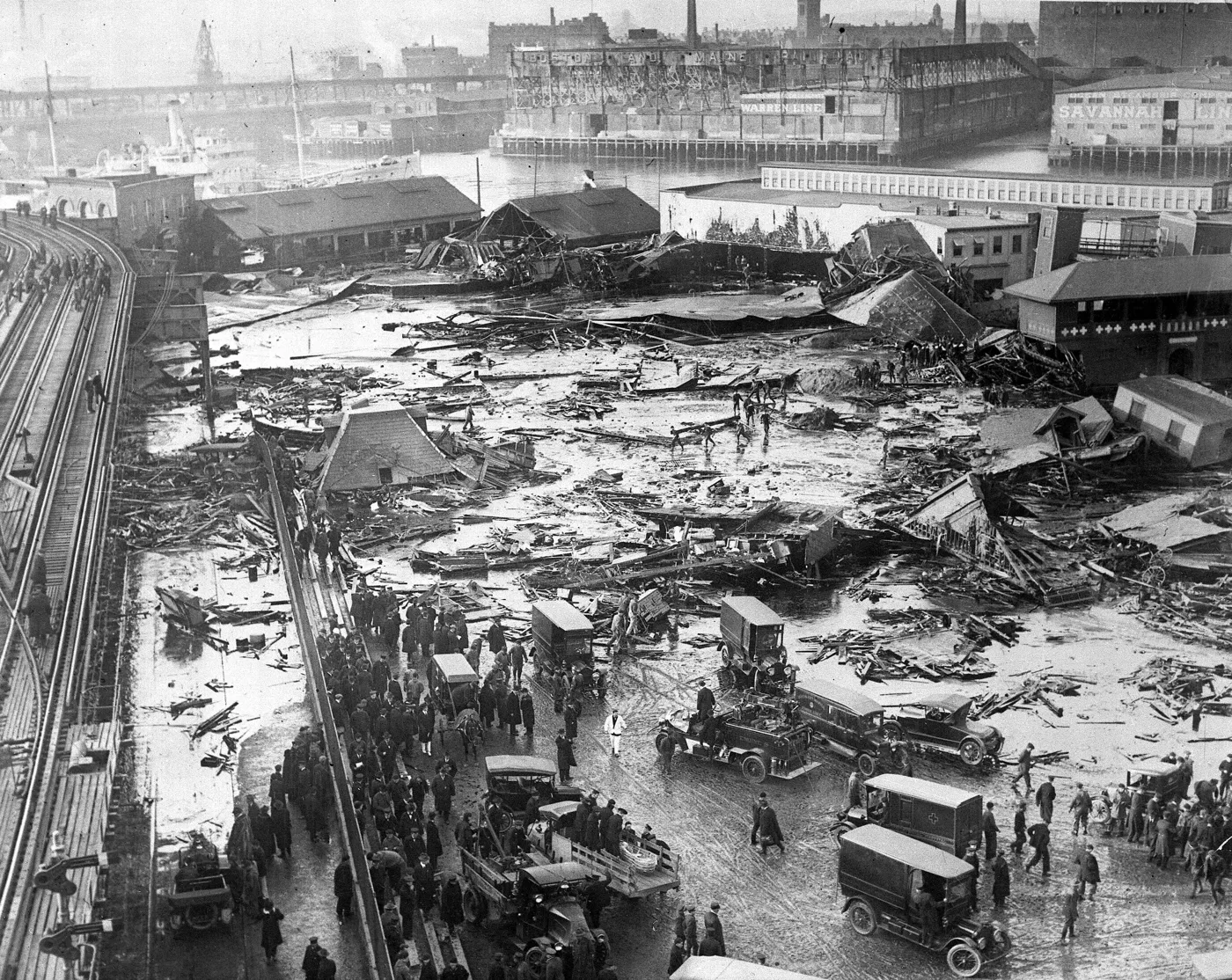
How many people died in the Great Molasses Flood?
Twenty-one people died and about 150 were injured. Both HISTORY.com and the Smithsonian article give those totals, and so does NBC News. Several victims stayed missing for days. A wagon driver named Cesare Nicolo was not found in Boston Harbor until almost four months after the flood, HISTORY.com reports.
The first newspaper count was lower. The New York Times headline on the day said 12 were killed, as Wikipedia notes. The final count rose as workers dug through the wreckage.
What caused the tank to burst?
The courts blamed the tank. HISTORY.com says the company built it quickly and carelessly in 1915. It groaned, leaked and was only re-caulked, even after one employee warned that it was unsound. The Smithsonian article says the court found the “factor of safety” was too low, so inspections had not been tough enough.
The company, United States Industrial Alcohol (USIA), argued that anarchists had blown up the tank. A man had phoned USIA’s office in 1918 and threatened to destroy it with dynamite, HISTORY.com notes. The court did not accept the sabotage claim.
Warm weather probably played a part. The plaque at the park says structural defects combined with unseasonably warm temperatures. Wikipedia adds that a ship had delivered a fresh, warmed load of molasses the day before, and it suggests that expansion of the older, colder molasses inside may have helped split the tank. Treat that last point as a theory.
NBC News asked a fluid-dynamics expert why molasses moved so fast. Molasses is dense, she said, and for the first 60 to 90 seconds its weight mattered more than its stickiness. Then it slowed, became thicker in the cold and trapped people.
Rescue and cleanup after the Great Molasses Flood
Police and firefighters arrived within minutes, and so did sailors from the USS Nantucket. HISTORY.com says there were over a hundred sailors. Wikipedia says 116 cadets from the Massachusetts Nautical School ship. The molasses was starting to harden in the winter air, so rescuers struggled to wade through it.
At the Engine 31 firehouse, men were trapped in a pocket of space on the collapsed first floor. Workers freed the survivors after several hours, but one firefighter drowned. More than 300 workers then cleared the wreckage. Firefighters used brooms, saws and saltwater pumps on the last of the syrup. The harbor stayed brown until summer, and the smell hung over the North End for months, HISTORY.com says. Edwards Park wrote in the Smithsonian that it lasted for decades.
Who paid for the Great Molasses Flood?
Victims filed 119 lawsuits against USIA. The cases were joined into one proceeding that ran five years, with more than 1,500 exhibits and about 1,000 witnesses. Wikipedia calls it one of the first class-action suits in Massachusetts. In April 1925, state auditor Hugh W. Ogden ruled that USIA was to blame, HISTORY.com reports.
The amount paid depends on the source. HISTORY.com says USIA paid $628,000. The Smithsonian article says more than 100 claims were settled out of court for $500,000 to $1,000,000, with about $7,000 reportedly going to the family of each person killed. The table below puts both side by side.
Great Molasses Flood timeline
Dates and events below come from the sources named in the last column. The table can be sorted by clicking a column header.
| Date | What happened | Source |
|---|---|---|
| 1915 | A steel molasses tank, about 50 feet tall, is built on Commercial Street in the North End. Smithsonian says Purity Distilling Company built it; HISTORY.com says United States Industrial Alcohol (USIA) did. | Smithsonian, Nov 1983; HISTORY.com |
| 1917 | Purity Distilling sells out to United States Industrial Alcohol. | Smithsonian, Nov 1983 |
| January 15, 1919, about 12:30 p.m. | The tank bursts. About 2.3 million gallons of molasses sweep through Commercial Street; 21 people die and about 150 are hurt. HISTORY.com gives 12:40 p.m. | Smithsonian, Nov 1983; HISTORY.com |
| January 15, 1919, afternoon | Police, firefighters and sailors from the USS Nantucket reach the scene. Survivors are pulled from the Engine 31 firehouse after several hours. | HISTORY.com |
| 1919 | Victims file 119 lawsuits against USIA, which says the tank was blown up by saboteurs. | HISTORY.com |
| Summer 1919 | Boston Harbor stays stained brown until summer; the smell lingers in the North End for months. | HISTORY.com |
| April 1925 | State auditor Hugh W. Ogden rules that USIA is to blame, after a five-year proceeding. HISTORY.com says USIA later paid $628,000 in damages. | HISTORY.com |
| January 15, 2019 | The 100th anniversary: a ceremony at Langone Park, and a radar survey (UMass Boston Fiske Center) of where the tank stood. | UMass Boston Fiske Center blog, Jan 14, 2019 |
Figures that differ between sources
Accounts of the Great Molasses Flood do not agree on every number. Wave height is the biggest gap, from 8 feet on a library photo caption to 40 feet on the plaque. We did not pick a winner. Every figure below is attributed.
| Measure | Figures, by source | Source |
|---|---|---|
| Time the tank burst | About 12:30 p.m. (Smithsonian, 1983); about 12:40 p.m. (HISTORY.com) | Smithsonian, Nov 1983; HISTORY.com |
| Height of the wave | 8 feet (Boston Public Library photo caption); 15 feet (Smithsonian, HISTORY.com); 25 feet and 160 feet wide at the start (NBC News, 2019); 40 feet (wording of the plaque at the park, as transcribed by Wikipedia) | BPL photo caption; Smithsonian 1983; HISTORY.com; NBC News Jan 14, 2019; Wikipedia |
| Size of the tank | About 50 feet tall and 90 feet across (Smithsonian, 1983); 58 feet high and 98 feet across (HISTORY.com photo caption) | Smithsonian, Nov 1983; HISTORY.com |
| Amount paid after the flood | $628,000 in damages (HISTORY.com); between $500,000 and $1,000,000 paid out of court, about $7,000 per victim reported (Smithsonian, 1983) | HISTORY.com; Smithsonian, Nov 1983 |
| People killed | 21 dead and about 150 injured in every source above; the first New York Times headline said 12 killed (as cited by Wikipedia) | Smithsonian; HISTORY.com; NBC News; Wikipedia |
Where to see the Great Molasses Flood site today
Go to Commercial Street in the North End, near Copp’s Hill. The tank stood where Langone Park is now. A small plaque at the entrance to Puopolo Park, placed by The Bostonian Society, tells the story, according to Wikipedia. We have not checked the plaque wording on site, and it gives a wave height of 40 feet.
For the 100th anniversary on January 15, 2019, a ceremony was held at the park and the 21 names were read aloud. Before it, the University of Massachusetts Boston’s Fiske Center ran a radar and conductivity survey of the park. It found a hard layer about 50 centimeters (20 inches) under the ground that could be the tank’s remains. The team called that cautious and noted the same signal could come from the old infield.
The park is a short walk from other places on our Freedom Trail map, including Copp’s Hill and Old North Church. Read more about the area on our North End page, or see all Boston neighborhoods. Much of this waterfront is filled land, which our Boston made land article explains. More Boston history: the first subway in America and the Big Dig.
Sources
Flood account, lawsuits and aftermath: HISTORY.com, The Great Molasses Flood. Tank, time and payments: Edwards Park, “Without Warning, Molasses in January Surged Over Boston,” Smithsonian, November 1983 (reprint). Wave size and physics: NBC News, January 14, 2019. Radar survey: UMass Boston Fiske Center, January 14, 2019. Plaque, cadets and the 1919 newspaper count: Wikipedia, Great Molasses Flood (secondary; it cites the New York Times and Stephen Puleo’s book Dark Tide). Photo: Boston Public Library, public domain, via Wikimedia Commons. Copies of every page we read are kept in our research files.
Great Molasses Flood: frequently asked questions
It happened on January 15, 1919, at about 12:30 p.m. according to the Smithsonian, or 12:40 p.m. according to HISTORY.com.
Twenty-one people died and about 150 were injured, according to HISTORY.com, the Smithsonian and NBC News.
It happened on Commercial Street in the North End of Boston, opposite Copp’s Hill. The tank stood where Langone Park is now.
About 2.3 million gallons. HISTORY.com and the Smithsonian article both give that figure.
Sources estimate about 35 miles per hour. They disagree on its height: 8, 15, 25 or 40 feet, depending on the source.
A court found the tank was poorly built and inspected. The company said saboteurs blew it up, but state auditor Hugh W. Ogden ruled in April 1925 that the company was to blame. A mild day may have added to the strain.
Yes. Langone Park and Puopolo Park are on Commercial Street in the North End, and a small plaque there describes the disaster. Nothing remains of the tank above ground.
Questions and answers
- 0 votes1 answer
When did the Great Molasses Flood happen?
Where and when was the molasses disaster?
Ask a question about this article
Log in to take part.