Big Dig Boston: What It Built, What It Cost and What to See Today
The Big Dig in Boston, officially the Central Artery/Tunnel Project, replaced the elevated Central Artery highway with an underground expressway and extended the Massachusetts Turnpike to Logan Airport. Construction began in September 1991, and MassDOT dates “majority completion” to January 13, 2006. The cost was about $14.6 billion by 2003 and nearly $15 billion by 2008, or about $22 billion once interest is counted.
Facts read November 22, 2026 · Sources listed at the end · Photo: Carol M. Highsmith, Library of Congress, public domain · Where sources differ, we show both
What was the Big Dig in Boston?
MassDOT calls the Central Artery/Tunnel Project the largest, most challenging highway project in the history of the United States. It had two parts. The first replaced the six-lane elevated Central Artery (I-93) with an underground highway and two new bridges over the Charles River. The second extended I-90 through a tunnel under South Boston and Boston Harbor to Logan Airport and Route 1A.
Why did Boston replace the Central Artery?
The old highway was jammed. MassDOT says the elevated Central Artery carried about 75,000 vehicles a day when it opened in 1959. In the early 1990s it carried upwards of 200,000. Traffic crawled for more than 10 hours a day, and the accident rate was four times the national average.
The elevated road also cut the North End and the waterfront off from downtown. MassDOT says it displaced 20,000 residents. It estimated that congestion cost drivers $500 million a year.
What the Big Dig built
MassDOT gives these figures on its project pages:
- Length: 7.8 miles of highway and 161 lane-miles, about half in tunnels (project background). The facts page says a 7.5 mile corridor.
- Concrete and dirt: 3.8 million cubic yards of concrete placed and more than 16 million cubic yards of soil excavated.
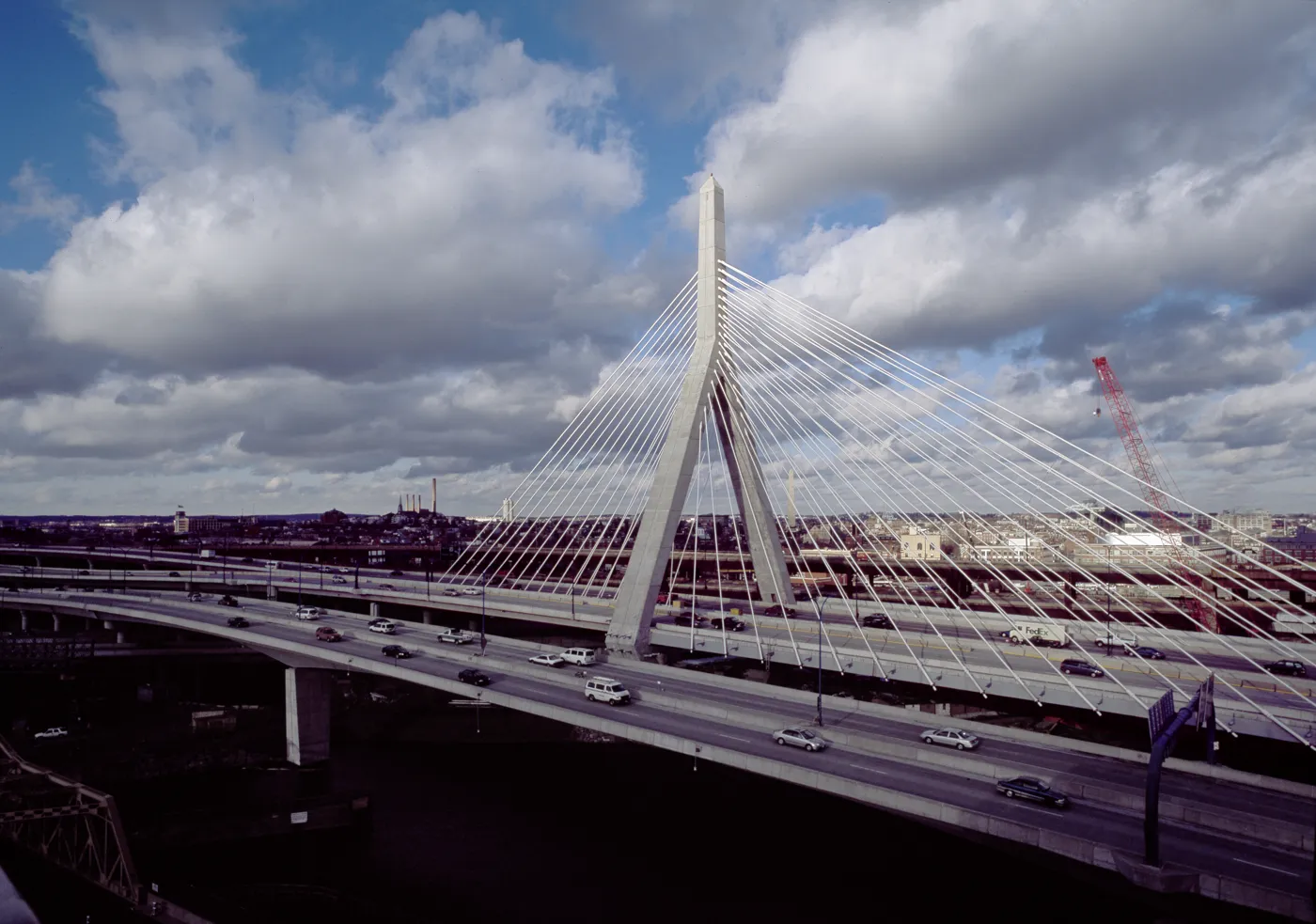
- Zakim Bridge: the Leonard P. Zakim Bunker Hill Bridge is the widest cable-stayed bridge in the world and the first hybrid, asymmetrical design in the United States. It was completed in 2002.
- Tunnels: the Ted Williams Tunnel finished in December 1995. The I-90 connector opened in January 2003, I-93 northbound in March 2003 and I-93 southbound in December 2003.
- Parks: more than 300 acres of new parks and open space, including 27 acres where the elevated highway stood and 105 acres at Spectacle Island.
- Contracts and workers: 118 construction contracts, and about 5,000 workers at the peak.
How much did the Big Dig cost?
The answer depends on the date and on whether interest counts. A 2003 report from the National Academies put the original estimate at $2.6 billion, in 1982 dollars, from the 1985 environmental impact statement. Other summaries give $2.8 billion. The same report put the current estimate at $14.6 billion, and said about half of the growth came from inflation.
The Boston Globe reported on July 17, 2008, that the price tag was nearly $15 billion. It added that interest would bring the total to about $22 billion, with the debt not paid off until 2038. The Globe said Massachusetts drivers and taxpayers paid 73 percent of construction costs. The federal government paid 27 percent, about $4 billion.
What went wrong with the Big Dig?
On July 10, 2006, ceiling panels fell in the I-90 connector tunnel at the D Street portal, at about 11:01 p.m. One passenger was killed and the driver had minor injuries. The National Transportation Safety Board found that the epoxy used to hold the ceiling anchors had poor creep resistance, so it deformed and let the anchors pull free. The Board also said the Massachusetts Turnpike Authority had no timely tunnel inspection program.
The debt was the other problem. The Globe’s 2008 review described a state “reeling” under the debt and said Massachusetts had spent less than its peers on other roads and bridges.
Did the Big Dig fix Boston traffic?
MassDOT says total vehicle hours on project highways dropped 62 percent from 1995 to 2003. It estimates $168 million a year in time and cost savings for travelers and a 12 percent drop in citywide carbon monoxide. These are the agency’s own figures, so treat them as the official case for the project. To see how commutes look across the region now, check our Greater Boston commute times page.
Big Dig timeline
The table lists the main dates from MassDOT, the NTSB and the Greenway Conservancy.
| Date | What happened | Source |
|---|---|---|
| 1959 | The elevated Central Artery opens, carrying about 75,000 vehicles a day. | MassDOT, Big Dig: project background |
| 1982 | Planning for the Central Artery/Tunnel Project begins. | MassDOT, Big Dig: project background |
| April 1987 | Congress approves federal funding and the basic scope of the project. | MassDOT, Big Dig: project background |
| September 1991 | Construction begins, on the South Boston bypass road and the Ted Williams Tunnel. | MassDOT, Big Dig: project background |
| 1995 | The Ted Williams Tunnel opens to commercial traffic (finished December 1995). | MassDOT, Big Dig: project background |
| 1999 | Construction is about half complete. | MassDOT, Big Dig: facts and figures |
| 2002 | The Leonard P. Zakim Bunker Hill Bridge is completed. | MassDOT, Big Dig: project background |
| 2003 | The I-90 connector to Route 1A opens in January, I-93 northbound in March, I-93 southbound in December. | MassDOT, Big Dig: project background |
| 2004 | The elevated Central Artery is taken down. | MassDOT, Big Dig: project background |
| January 13, 2006 | MassDOT dates the "majority completion" of the project to this day. | MassDOT, Big Dig: project background |
| July 10, 2006 | Ceiling panels fall in the I-90 connector tunnel at the D Street portal; one passenger is killed. | NTSB investigation HWY06MH024 |
| 2006 | Spectacle Island Park opens to the public. | MassDOT, Big Dig: project background |
| October 2008 | The Rose Kennedy Greenway opens to the public. | Rose Kennedy Greenway Conservancy, History |
Where to see the Big Dig today
- Rose Kennedy Greenway: the park runs through the old highway path from Chinatown through the Wharf District and the North End. It opened in October 2008, according to the Greenway Conservancy, which says the park has historical and interpretive markers and maps.
- Zakim Bridge: look for it from Charlestown and near North Station, where the cable-stayed span crosses the Charles River.
- Ted Williams Tunnel: you pass through it on I-90 to Logan Airport, which is the first part of the project that opened.
- Spectacle Island: a 105-acre park in Boston Harbor built on a capped former dump with soil from the project.
MassDOT says about three quarters of the 27 downtown acres stay open, with a quarter set aside for low-rise buildings. Its other page says 30 downtown acres. Walk the park from Downtown to the North End, or see the Charlestown side of the bridge. The Big Dig worked on ground that was filled long before, as our Boston made land article shows. More Boston history: the Great Molasses Flood and the first subway in America.
Sources
Project facts and milestones: MassDOT, The Big Dig: project background (read from the Internet Archive copy of January 1, 2025) and The Big Dig: facts and figures (copy of December 12, 2025). Original estimate: National Academies, Completing the Big Dig, 2003. Cost with interest and the federal share: Boston Globe, July 17, 2008, “Big Dig’s red ink engulfs state”. Ceiling collapse: National Transportation Safety Board, investigation HWY06MH024. Greenway: Rose Kennedy Greenway Conservancy, History. Photo: Carol M. Highsmith, Library of Congress, public domain, via Wikimedia Commons.
Big Dig Boston: frequently asked questions
The Big Dig was the Central Artery/Tunnel Project. It replaced Boston’s elevated Central Artery highway with an underground expressway and extended I-90 to Logan Airport.
Construction began in September 1991. MassDOT dates majority completion to January 13, 2006, and the I-93 tunnels opened in 2003.
About $14.6 billion in a 2003 National Academies report and nearly $15 billion in a 2008 Boston Globe review. The Globe estimated about $22 billion once interest is included. The original estimate was $2.6 billion in 1982 dollars.
An underground highway took the traffic, and the Rose Kennedy Greenway now covers the old path. The Greenway opened in October 2008.
On July 10, 2006, ceiling panels fell in the I-90 connector tunnel and killed a passenger. The NTSB blamed an epoxy with poor creep resistance and the lack of a timely inspection program.
The Rose Kennedy Greenway, the Zakim Bridge, the Ted Williams Tunnel and Spectacle Island all came from the project.
Questions and answers
- 0 votes1 answer
When did the Big Dig construction begin and end?
What was the timeline and cost of the Big Dig?
Ask a question about this article
Log in to take part.